
Androniki Michalopoulou is a 27-year-old Greek footballer who currently plays for Puskás Akadémia in Hungary. In this interview, Androniki shares her experience as a graduate of the Master in Sport Business Online at Johan Cruyff Institute
At 27, Androniki Michalopoulou already has a long career in women’s football. She has played both in her home country, Greece, and in teams from Poland, Romania, and Hungary, where she currently plays. She is also a member of the Greek national team.
Alongside her sports career, Androniki graduated from the Master in Sport Business Online at Johan Cruyff Institute. She was one of the eight athletes awarded a scholarship by The Cruyff Athlete Fund for the 2023–24 academic year.
In this interview, Androniki looks back on her academic experience, explains how she balanced her sporting life with her studies at Johan Cruyff Institute, and reflects on the social importance of sport.
How has your experience competing in different countries and leagues influenced your development as a footballer?
The first thing I would say is that playing in different teams gave me the chance to see real-life examples of many of the things I was studying in the Master. Whether it was fan engagement or facility management, I could observe firsthand how the industry I was analyzing actually worked.
To put it into context: I’m 27 and I’ve been playing football for a little over a decade. Of those years, I’ve spent five playing professionally abroad: three in Poland, two in Romania, and now I’m competing in Hungary. I’ve also played for the Greek national team and taken part in some UEFA Champions League qualifying rounds.
This variety, this range of levels I’ve experienced, is incredible. Because as a footballer, but also from a sports management perspective, it’s fascinating to see sport in its full scope. We tend to always think of the elite, but football —like sport in general— also includes grassroots, academies, regional football, and even local leagues. It’s not all national and international. I’ve had the chance to see that whole spectrum.
Some people might move once, twice, or three times in their lives. I practically move every season. And I don’t just change cities; I change countries. That’s why adaptation is crucial.
“Playing in different countries develops a strong ability to adapt, something that becomes a strength even beyond football. And when you play abroad, everything becomes more complex. Simple things, like communication, can turn into a challenge.”
What made you choose the Master in Sport Business Online, and what was the most impactful part of the program?
From a young age, with the first contract I signed, I knew I wanted to continue my education. I studied a degree in Political Science and Public Administration in Athens, and from the beginning I knew I wanted to do a Master. I had a general idea that I wanted to enter the sports industry, but I was still exploring.
At that time—2021–2022—we were in the middle of the pandemic. Many universities were starting to offer online programs due to mobility restrictions. And that’s when I discovered Johan Cruyff Institute, whose online programs had already existed for more than a decade. That experience in online education was key for me.
As a footballer, I had no idea where I would be the following season. In fact, during the two years I studied the master, I lived in three countries and played for four different clubs.
“Johan Cruyff Institute offered exactly what I needed: solid online-learning experience, the possibility to understand the sports industry from the inside, good professors, and students truly committed to the sector.”
I learned a lot. I just finished the master, so I still need some time to process everything, but even now I can say it was an incredible experience. As a footballer, I was able to understand from the inside everything I was studying.
Each module —innovation, sustainability, sports law, facility management— allowed me to see the industry from another angle. Not from the outside, but from a different perspective. I discovered things I didn’t even know existed.
I understood data and figures. And because I’ve played in big and small clubs, I could see live what I was studying: fan engagement, ticketing, academy expansion… I was there. It was amazing to understand the industry from the inside.
How do you balance your academic commitments with the demands of professional football?
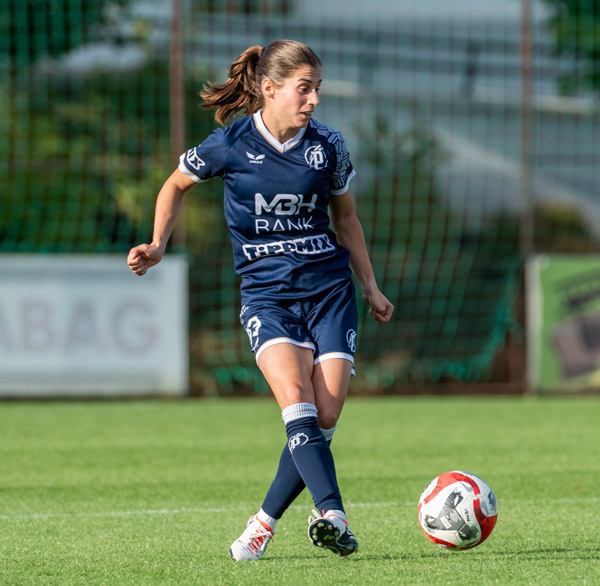
Currently, Androniki Michalopoulou plays for Puskás Akadémia in Hungary.
The short answer would be: it’s difficult. When I started the program, my biggest concern was time management. But in practice, I discovered that I did have time.
The problem wasn’t time; it was energy. Energy management. I moved around a lot during those two years. The national team also required a lot. There were many assignments. My roommate would say: “You’re studying for the master again…?” Yes, but I enjoyed it. It wasn’t stress; it was a matter of focus.
Could I, after a long day or week, study all those articles and review almost unlimited resources? That was the challenge.
Some months were easier than others, I admit it. But in the end, if you want to make it work, you make it work. Sometimes I submitted assignments late, other times I worked very quickly if I had more energy. But I did it. I’m proud of finishing it. And yes: it was a challenge. It is for anyone.
In what ways do you think your education in sports management will influence your career when you retire?
Retirement is something you think about, of course. I’ve achieved my dream of becoming a professional, so while I’m active, that’s my priority.
But you learn quickly that your career is limited. You can’t play forever. I’m at an age where I know I still have a few years, but I can count them.
“You need a plan. I’ve seen situations where an injury changes everything from one day to the next. An athlete’s career is fragile.”
Many people leave football because football leaves them first. That’s why you need a plan B—or rather, a dual career. It’s healthier to see it that way: not as “I do this and also that,” but as a natural evolution.
Today you play; tomorrow you might not. I don’t know when retirement will come. But thinking about that moment, there are many areas of sport that interest me.
“During the Master in Sport Business Online, I discovered a strong interest in facility management. As a footballer, I see what’s needed to be more efficient, what fans expect.”
Facility management is something I wouldn’t have considered two years ago, and now I do. I’m also very organized, so roles like sporting director or team manager appeal to me.
And thinking outside the usual path: I’m very interested in community sport. It’s not all about clubs or teams. I’d like, maybe one day, to return to Greece and work at a municipal or regional level, in sports projects or events.
I deeply believe that sport brings people together. If someone asks me how many languages I speak, I say “sport.” I’ve lived it: sport unites. And there’s no better way to bring cities or countries together. So yes, community sport is a path I might follow.
What key lessons from your football career do you think will be most valuable when moving into leadership or management roles in the sports industry?
First: adaptability. As an athlete, you have to make things work. You’re expected to perform. You need to find solutions. To be part of the solution, not the problem. If all you do is complain, your career won’t last. You need to find answers.
Then, teamwork. You need to be a team player. My brother told me: “Nicky, you have strengths. Make them even stronger.” And also: “You have weaknesses. Improve yours.” But your weaknesses might be someone else’s strengths.
In a team—or in a leadership role—you need to assign tasks to the people who can do them best. If something is hard for me and I’ll do it poorly, and someone else can do it more easily and better, it makes sense to distribute responsibilities according to each person’s strengths.
“Teamwork is something you learn as an athlete and that transfers directly to any later role.”
And finally, clarity and honesty. If you have a goal, you have direction. If you don’t, you move without purpose. It might work, but how do you evaluate it afterward? How do you know you’ve improved if you don’t have references, indicators, goals?
In the clubs where all 20, 30, or 40 of us knew the objective from the beginning, we achieved good results. We had direction. In those where there was no clarity, everything was left to chance.


