
This year, all lecturers at Cruyff Education in the Netherlands are taking part in the training program “Cruyffian Coaching: the Study Coaching of Student-Athletes.”
How do you bring Johan Cruyff’s philosophy to life in education? How do you translate his vision on people, sport and talent development into the study coaching of student-athletes? What exactly is Cruyffian coaching, and what makes it distinctive? These questions marked the starting point, a year ago, for the development of the new training program “Cruyffian Coaching: The Study Coaching of Student-Athletes.” Under the leadership of Joyce van Kooten, education expert and lecturer at the Johan Cruyff Academy, team leaders at Cruyff Education began shaping the program.
Recently, lecturer-trainers Joyce van Kooten and Bram Lomans delivered the first training day to lecturers and staff of Johan Cruyff College Amsterdam. The result was a session full of energy, reflection and, above all, a shared effort to define what Cruyffian coaching truly means.
Not a prescribed model, but shared ownership
One thing stood out immediately: the openness of the group. While Joyce and Bram had anticipated some resistance beforehand (“Haven’t we been doing this well for years already?”), the atmosphere turned out to be curious and constructive. “We weren’t there to lecture,” Bram explains. “We want to build together what Cruyffian coaching really is. The group felt ownership, and that’s exactly what we were aiming for.”
The two-day training is designed as an interactive process. It does not start from rules or dogmas, but from dialogue, recognition and shared values. After all, Cruyff Education, an innovator and leader in education for and with elite athletes, has built up more than 25 years of experience. The Cruyffian Coaching training helps current lecturers and staff to deepen that experience and connect it more consciously within the study coaching of student-athletes.
Cruyffian Coaching: A holistic, people-centred perspective
During the training day, it became clear how closely Cruyffian coaching aligns with lecturers’ day-to-day practice. At the same time, there is a distinctive “Cruyffian touch” that makes the difference:
- Seeing the person behind the athlete. Looking beyond sporting performance or study behavior alone, and taking the full picture into account: sport, education, home situation, ambitions and mental load.
- Working from the energy of sport. Using elite sport analogies to make study-related themes tangible and recognizable for student-athletes, for example when discussing discipline, setbacks, motivation or dealing with injuries.
- The brand paradoxes of Cruyff Education. Reflecting who Johan Cruyff was, such as intuitive versus rational, idealistic versus commercial, and rebellious versus social—can help our lecturers navigate complex situations with greater flexibility.
- Powerful inspiration from Johan Cruyff’s life and quotes. Using cards with authentic examples and quotations, lecturers are able to learn how to apply Johan Cruyff’s philosophy in a practical way in their coaching of student-athletes.
“How do you use this in your teaching, and how do you show it to your student-athletes?” is the guiding question throughout the training, Joyce explains.
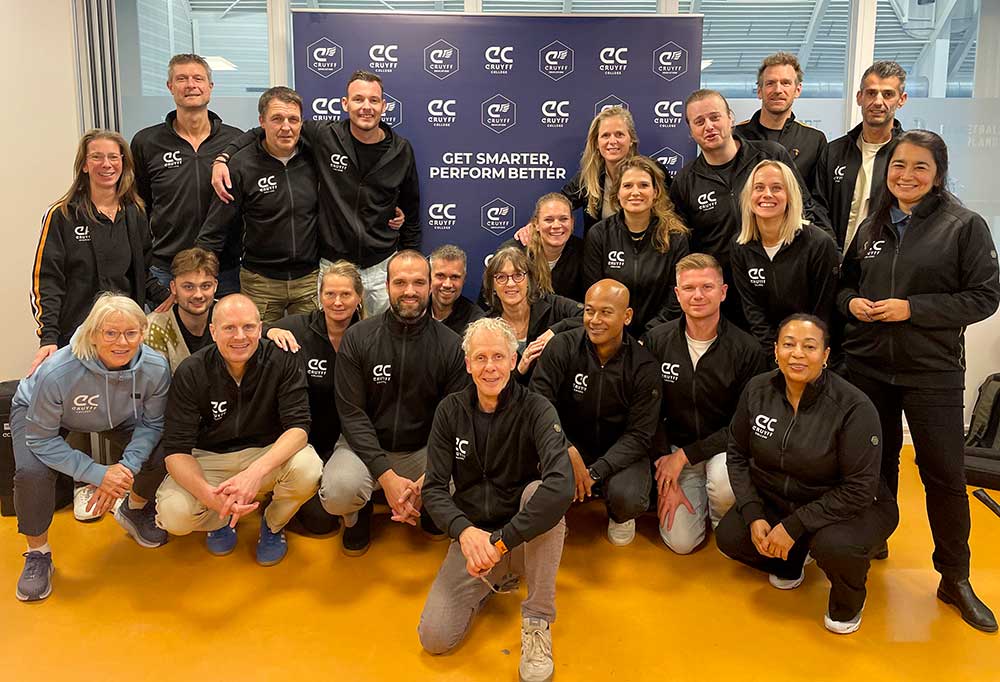
The Johan Cruyff College Amsterdam team with trainers Joyce van Kooten (back left) and Bram Lomans (second from the right, back row).
Practical methods with a Cruyffian touch
The training program includes a wide range of practical formats in which lecturers actively engage, such as:
- Paradox role-plays to practice advocating for student-athletes within an educational organization.
- Building ‘personas’, based on Paul Wylleman’s framework and the Long-Term Athlete Development (LTAD) model, to better understand ‘typical’ student-athletes
- Designing lesson openings using Cruyff quotes, a light yet powerful way to introduce Cruyffian thinking into a group.
- Reflecting on professional values using the so-called Cruyff Education values fan, with concrete examples of how the nine core values can be made visible in the daily practice of study coaching at Cruyff Education.
The methods proved to be both surprisingly recognizable and inspiring. “Lecturers themselves said: we can actually apply this quite easily and much more often in our own coaching sessions,” Bram notes.
The Cruyffian core: Encouraging self-direction
A key theme in the training is self-regulation: helping student-athletes consciously take ownership of their studies, planning and decision-making. Within the training, this is linked to:
- Self-determination theory (autonomy, competence and relatedness), giving the study coaching of student-athletes a strong foundation in widely used educational concepts.
- Cruyff’s style of leadership: giving freedom, gathering ideas, but also making decisive choices when it really matters.
Self-direction is not always easy—especially with strong-willed, driven student-athletes (or colleagues). But that is precisely what makes it so Cruyffian. “Being headstrong can be challenging, but it’s also incredibly valuable,” Joyce says. “It’s part of elite sport and deserves space.”
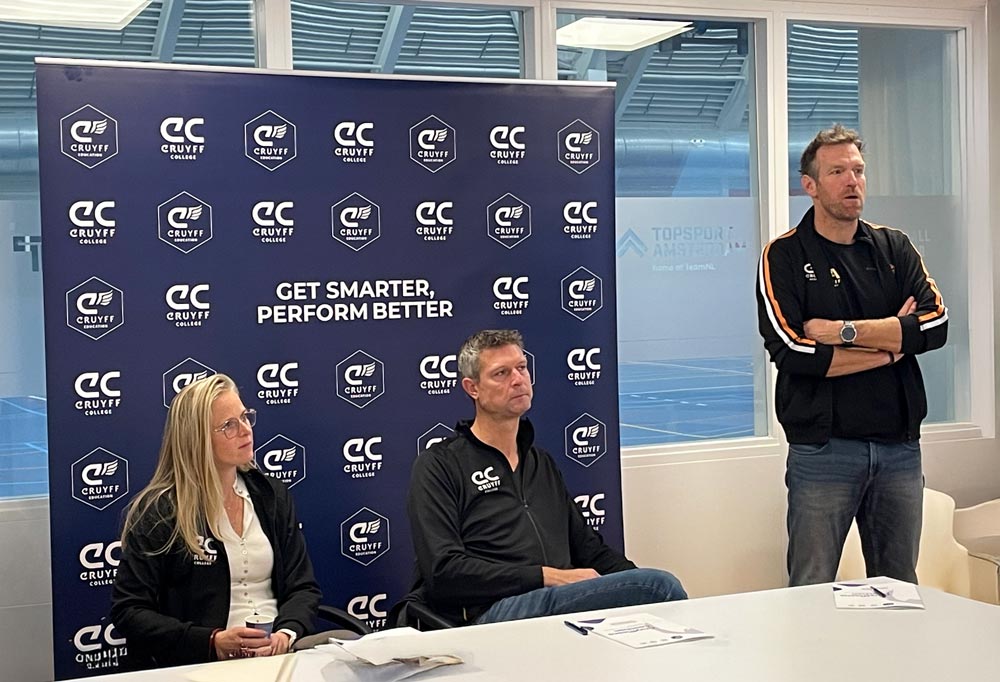
Bram Lomans (on the riight) with two colleagues from Johan Cruyff College Amsterdam
Learning together, growing together. Bringing vocational and higher education closer
The training also has a broader impact: lecturers from Johan Cruyff College and Johan Cruyff Academy get to know each other, and each other’s educational approaches, better.
“This strengthens the transition from secondary vocational education at Johan Cruyff College to higher professional education at Johan Cruyff Academy, and contributes to one clear and recognizable Cruyff Education identity,” Bram explains. “That is also important for how we communicate externally.”
Engaged conversations took place, with knowledge sharing about teaching methods, program design, the “sprints” at Johan Cruyff Academy and the “stages” at Johan Cruyff College, and both the similarities and differences in approaches to the study coaching of student-athletes.
A living legacy
Why is this training gaining such strong momentum right now? According to Joyce and Bram, it is largely due to the need, and the opportunity, to consciously keep Johan Cruyff’s academic legacy alive. No longer through Johan Cruyff himself, but through everyone within Cruyff Education who works with student-athletes.
Cruyffian Coaching, then, is not about imitation or applying fixed rules. It is about living, translating and applying a philosophy that is unique in the Netherlands, and of great value to student-athletes who combine their studies with a career in elite sport.
Cover photo: Dione Housheer, professional handball player and alumnus & ambassador Johan Cruyff Academy Amsterdam, credits photo: Henk Seppen.


