
A two-time Olympic gold medalist with the Dutch national field hockey team and a lecturer at Johan Cruyff Academy Amsterdam, Bram Lomans combines his elite sports experience with a passion for educating the next generation of sports professionals.
Winning Olympic gold in both Atlanta 1996 and Sydney 2000, Bram Lomans knows what it takes to perform at the highest level. Following a successful international career in field hockey, he now remains closely connected to sport through education as a lecturer and study coach at Johan Cruyff Academy Amsterdam, where he supports student-athletes in their academic and personal development.
In addition to his teaching role, Bram is part of the faculty for Johan Cruyff Institute’s new Personal Leadership & Coaching program in Heerenveen/Papendal, an initiative designed to develop leaders who understand themselves, inspire others, and approach the challenges of sport from a human-centered perspective. His educational philosophy is also reflected in the concept of Cruyffian Coaching, which promotes values such as authenticity, creativity, and learning through experience.
In this interview, Bram shares his thoughts on how sports education can better prepare students for the future of the industry, why authentic leadership matters, and the lessons high-performance sport can teach far beyond competition.
 How can sports education better prepare students for the future of the sports industry?
I believe it starts by bringing the reality of the workplace into the classroom. We learn a great deal from books and teachers, but the real learning begins when you face the challenges of the sports industry, whether they’re coming from major sports organizations, governing bodies, or other stakeholders. The best learning happens when students tackle real challenges from the sports industry.
If those organizations can bring their real-world challenges into the classroom and let students work on finding solutions, that’s probably the best learning experience possible.
“Books can only teach you so much, but once you step into the real world, you discover challenges that are completely different. In many cases, the industry has already evolved beyond what is covered in textbooks.”
That’s why integrating real-life case studies into the curriculum or giving students direct exposure to sports organizations is so valuable. At the end of the day, you learn much more by doing than by simply listening or studying. I think that’s one of the greatest opportunities we can offer our students.
What leadership quality do you think will be most important for the next generation of sports professionals, and why?
When it comes to self-leadership, I think the ability to stay focused is one of the most important qualities.
Today, there are distractions everywhere. Social media, for example, only shows the highlights of other people’s lives, making many people feel they’re not good enough or that they’ll never be the best, when in reality they’re doing just fine.
That’s why it’s so important to focus on your own work and stay committed to your dream, even if it doesn’t seem glamorous from the outside.
“Being able to stay focused and motivated is an essential leadership skill.”
If you can overcome that challenge, new opportunities will come much sooner than you might expect. Instead of worrying about what everyone else is doing, concentrate on your own path. That can take you a long way.
How are the principles of Cruyffian Coaching applied today by coaches, leaders, and educators?
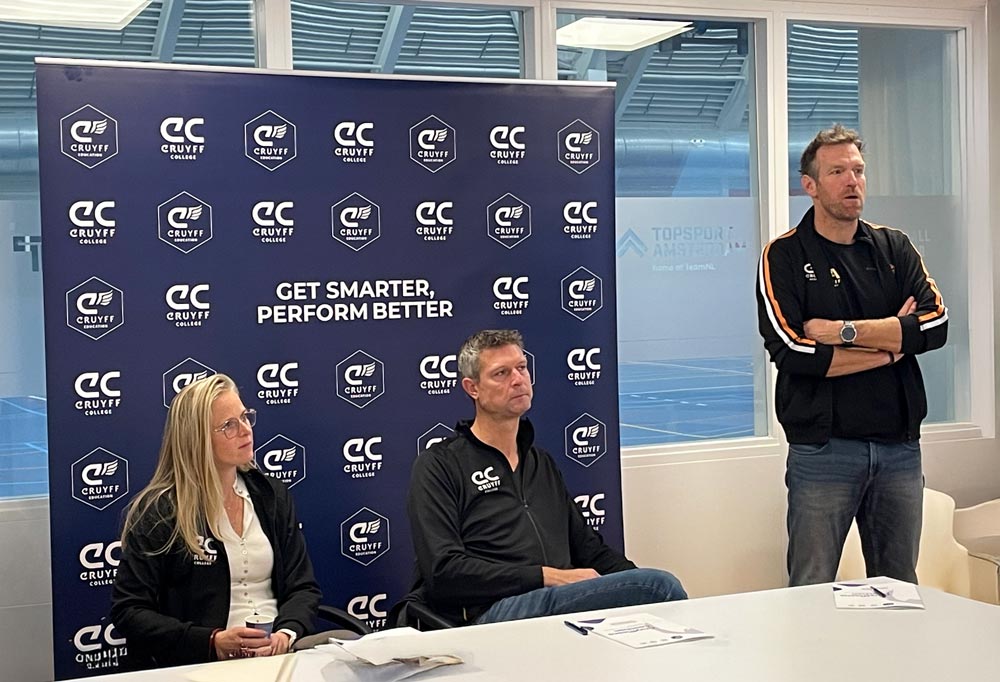
Bram Lomans (on the right) with two colleagues from Johan Cruyff College Amsterdam during the “Cruyffian Coaching: Study Coaching for Student-Athletes” training program.
That’s a difficult question because everyone interprets them in their own way.
What I like most about Johan Cruyff’s principles is that they place a strong emphasis on authenticity, being yourself. And that means something different for every individual.
I also believe they encourage people to explore the boundaries, not always take the most obvious path, or simply do what everyone else is doing or what you’re expected to do. If you see an opportunity just outside that path, I think you should go for it. It opens the door to new situations and different perspectives.
So I’d say authenticity, creativity, and perhaps that sense of boldness and ingenuity that characterized Cruyff, finding a different way of doing things, are three qualities that, if you embrace them as part of your personality and development, can make a tremendous difference.
What lessons from elite sport do you think every Johan Cruyff Academy student should learn?
I think one of the most important lessons is learning to focus on more than one thing at the same time.
Alongside being an athlete, it’s incredibly valuable to take on intellectual challenges as well. If your entire identity revolves around sport and you experience a setback, it’s much easier to lose confidence.
But if you have an exam the day after a disappointing result, you immerse yourself in your studies, stop dwelling on what happened, and return to training the next day with a fresh mindset. The same works the other way around.
That’s why I strongly believe in this combination. When I was a student myself, I didn’t fully appreciate how valuable that balance was. Looking back now, I understand how much it has given me.
“It’s important for students to realize that combining sports and studies is not only about earning a degree or preparing for a second career. It also helps them become better athletes.”
How has your experience as an Olympic champion influenced the way you teach and mentor future sports professionals?
I’m not only an Olympic champion; I’m also an alumnus of Johan Cruyff Academy. I think that combination allows me to truly understand where students are in their journey, what they’re going through, and where they want to go.
“I draw heavily on my own experiences from that period, when I was balancing life as both a student and an elite athlete. Those are probably the experiences I rely on most in my classes.”
Being an Olympic champion, or simply having been a full-time professional athlete, also gives me a certain level of credibility with students. I share many stories about training, commitment, and how to deal with setbacks.
People only see the gold medal, but they don’t see everything that came before it. There were countless difficult moments along the way. That’s probably the lesson I try to pass on most: setbacks are part of the journey. If you fail an exam, that’s okay, you’ll learn from it and move forward. If things don’t go your way, you’ll overcome it.
Those are probably the experiences I draw on most to guide, support, and inspire my students.


